À propos du cépage
Montepulciano est un cépage rouge, pays d’origine : Italie. Dans le cadastre viticole 2025 de l’Agence nationale du vin, il couvre 5,3 ha sur 12 parcelles, dont 5,3 ha dans la région Kakhétie.
Montepulciano is a red variety from central Italy, most likely native to Abruzzo; it has nothing to do with the Tuscan town's Vino Nobile, which is made from Sangiovese. Late-budding and late-ripening, it needs a warm site; its thick-skinned purple berries give deeply coloured, round and plummy reds with moderate acidity and soft tannins, the base of Montepulciano d'Abruzzo and Rosso Conero. In Georgia it is a rarity: Tchotiashvili grows it in Saniore for the red and rosé Nitsa and a blend with Tavkveri.
- Couleur de la baie
- rouge
- Origine
- Italieselon le passeport VIVC
- Manquant
- Pas de données : tanins
À quoi il ressemble
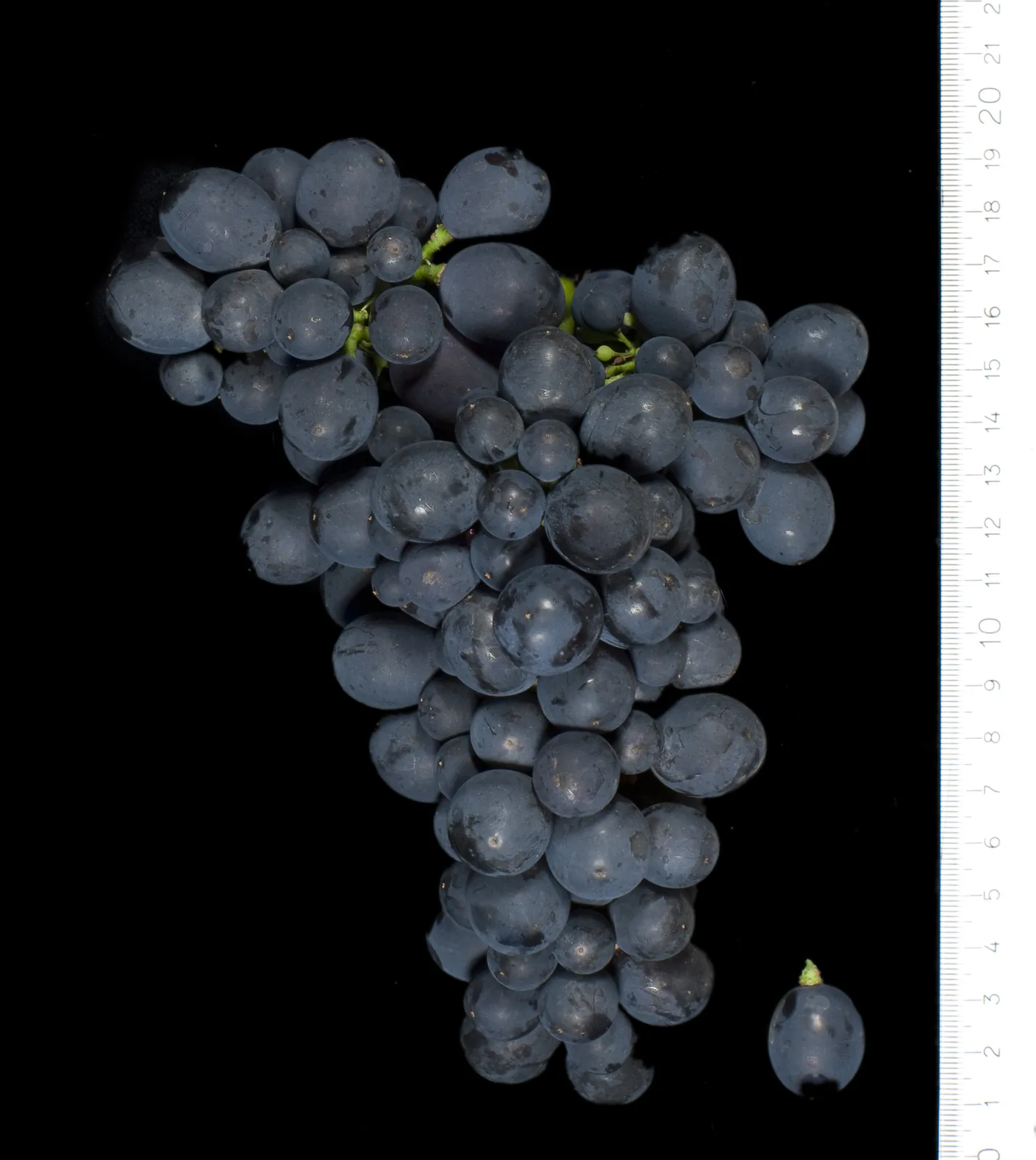
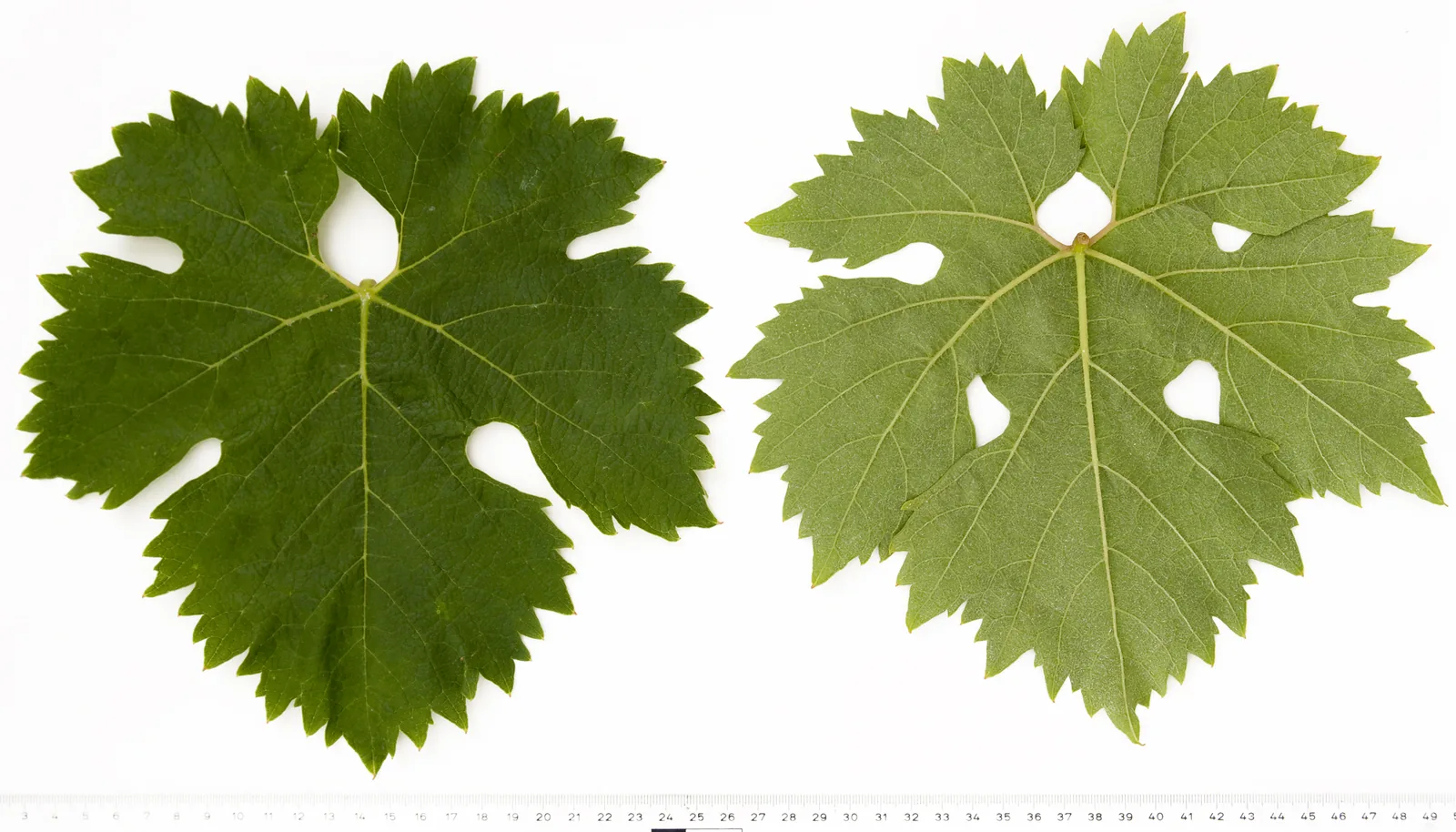
Grappe, baies et feuille
Géographie
Où il pousse
- Kakhétie5,3 ha · 100 %
4 vins
- Telavi4,2 ha · 79 %
- Autres municipalités1,1 ha
Cadastre viticole 2025, Agence nationale du vin : parcelles enregistrées sous ce cépage. Les vins par région proviennent de notre catalogue ; la région est connue pour 4 sur 4. 12 parcelles · Âge des vignes : avant 1990 — 0 ha, 1990–2009 — 4 ha, depuis 2010 — 1 ha
Ampélographie
Passeport du cépage
- Synonymes
- Africano, Angolano, Cordiscio, Cordisco, Cordisio, Montepulciano Cordesco, Montepulciano Cordisco, Montepulciano D'abruzzo
- Fleur
- hermaphrodite
- Usage
- cuve
- Conservé dans des collections
- 18
Bibliographie (10)
- REYNARD, J.-S.; BRODARD, J.; ROQUIS, D.; DROZ, E.; AVIA, K.; VERDENAL, T.; ZUFFEREY, V.; LACOMBE, T.; CROLL, D.; SPRING, J.-L.. A divergent haplotype with a large deletion at the berry color locus causes a white-skinned phenotype in grapevine. Horticulture Research, 12 uhaf069. 2025
- SCHNEIDER, A.; RUFFA, P.; TUMINO, G.; FONTANA, M.; BOCCACCI, P.; RAIMONDI, S.. Genetic relationships and introgression events between wild and cultivated grapevines (Vitis vinifera L.): focus on Italian Lambruscos. Scientific Reports 14 (5, Art. 12392) 121 pp.. 2024
- CRETAZZO, E.; MORENO SANZ, P.; LORENZI, S.; BENITEZ, M. L.; VELASCO, L.; EMANUELLI, F.. Genetic Characterization by SSR Markers of a Comprehensive Wine Grape Collection Conserved at Rancho de la Merced (Andalusia, Spain). Plants 11 (8, Art. 1088) 19 pp. 2022
- D’ONOFRIO, C.; TUMINO, G.; GARDIMAN, M.; CRESPAN, M.; BIGNAMI, C.; DE PALMA, L.; BARBAGALLO, M. G.; MUGANU, M.; MORCIA, C.; NOVELLO, V.; SCHNEIDER, A.; TERZI, V.. Parentage Atlas of Italian Grapevine Varieties as Inferred From SNP Genotyping. Frontiers in Plant Science 12 (Art. 605934) 16 pp.. 2021
- CRESPAN, M.; MIGLIARO, D.; LARGER, S.; PINDO, M.; PALMISANO, M.; MANNI, A.; MANNI, E.; POLIDORI, E.; SBAFFI, F.; SILVESTRI, Q.; SILVESTRONI, O.; VELASCO, R.; VIRGILI, S.; CARMILLI, G.. Grapevine (Vitis vinifera L.) varietal assortment and evolution in the Marche region (central Italy). OENO One (3) 17-37. 2021
- D'ONOFRIO, C.. Introgression Among Cultivated and Wild Grapevine in Tuscany. Frontiers in Plant Science 11 (Art. 202) 14 pp.. 2020
- LUCIANO DE OLIVEIRA, G.; PEREIRA DE SOUZA, A.; ANCELMO DE OLIVEIRA, F.; IMACULADA ZUCCHI, M.; MOURA DE SOUZA, L.; FERNANDES MOURA, M.. Genetic structure and molecular diversity of Brazilian grapevine germplasm: Management and use in breeding programs. PLOS ONE, October 15. 2020
- LORENZIS, G. DE; MERCATI, F.; BERGAMINI, C.; CARDONE, M. F.; LUPINI, A.; MAUCERI, A.; CAPUTO, A. R.; ABBATE, L.; BARBAGALLO, M. G.; ANTONACCI, D.; SUNSERI, F.; BRANCADORO, L.. SNP genotyping elucidates the genetic diversity of Magna Graecia grapevine germplasm and its historical origin and dissemination. BMC Plant Biology 19:7. 2019
- LAUCOU, V.; LAUNAY, A.; BACILIERI, R.; LACOMBE, T.; ADAM-BLONDON, A. F.; BERARD, A.; CHAUVEAU, A.; ANDRES, M. T. DE; HAUSMANN, L.; IBANEZ, J.; PASLIER, M. C. LE; MAGHRADZE, D.; MARTINEZ-ZAPATER, J. M.; MAUL, E.; PONNAIAH, M.; TÖPFER, R.; PEROS, J. P.; BOURSIQUOT. Extended diversity analysis of cultivated grapevine Vitis vinifera with 10K genome-wide SNPs. PLoS one, 13 (2) e0192540 1-27. 2018
- ALBA, V.; BERGAMINI, C.; GASPARRO, M.; MAZZONE, F.; ROCCOTELLI, S.; ANTONACCI D.; CAPU, A. R.. Basivin_SUD, La ricerca del germoplasma viticolo in Basilicata. Mario Adda Editore, Bari. 2016
Passeport VIVC n° 7949, Vitis International Variety Catalogue.
Vins
Vins du cépage Montepulciano

Nitsa
Tchotiashvili
Kakhétie
Vin élaboré par Tchotiashvili. Vin rouge sec de Géorgie, issu du cépage Montepulciano, région de Kakhétie. Vinifié selon la tradition du qvevri ; 13 % vol. Au nez : fruits rouges et griotte (d’après les descriptions publiées).

Montepulciano Oak Barrel
Marani Milorauli
Kakhétie
Vin rouge sec de Géorgie, issu du cépage Montepulciano, région de Kakhétie. Vinifié selon la méthode européenne, élevé sous bois ; 13,3 % vol. Au nez : griotte, notes florales et fruits rouges ; en bouche : corps ample (d’après les descriptions publiées). Producteur : Marani Milorauli.

Nitsa Rosé
Tchotiashvili
Kakhétie
Région de Kakhétie : vin rosé sec, issu du cépage Montepulciano. Vinifié selon la tradition du qvevri ; 13 % vol. Au nez : fruits rouges, griotte et notes florales (d’après les descriptions publiées). Vin élaboré par Tchotiashvili.
Tavkveri Montepulciano
Tchotiashvili
Kakhétie
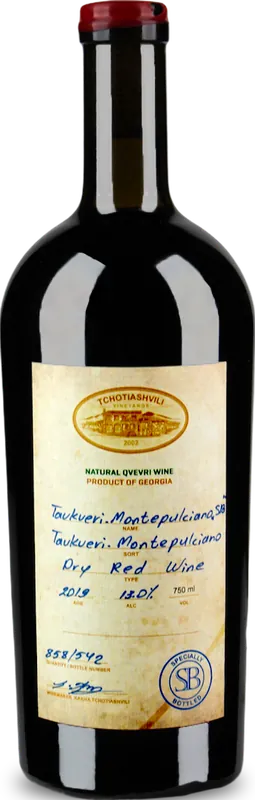
Région de Kakhétie : vin rouge sec, issu des cépages Tavkveri et Montepulciano. Vinifié selon la tradition du qvevri ; 13 % vol. Au nez : cannelle, notes florales et prune ; en bouche : corps ample (d’après les descriptions publiées). Vin élaboré par Tchotiashvili.
D’où viennent les données
Sources de cette page
Description
Faits tirés de sources ampélographiques et des registres officiels du pays, avec nos propres mots.
Photos
Photographies sous licence libre et photos de sites de caves ; la source de chaque cliché :
- Grappe · photo : Doris Schneider, Ursula Brühl, Julius Kühn-Institut (JKI), Federal Research Centre for Cultivated Plants, Institute for Grapevine Breeding Geilweilerhof - 76833 Siebeldingen, GERMANY / VIVC, This photo can be reproduced
- Feuille · photo : Ursula Brühl, Julius Kühn-Institut (JKI), Federal Research Centre for Cultivated Plants, Institute for Grapevine Breeding Geilweilerhof - 76833 Siebeldingen, GERMANY / VIVC, This photo can be reproduced
Surface de vignoble
Cadastre viticole 2025, Agence nationale du vin : parcelles enregistrées sous ce cépage ; les parcelles sans cépage identifié ne sont pas comptées.
Passeport et origine
Vitis International Variety Catalogue (VIVC).
Vins
Notre catalogue : la composition en cépages provient du site de la cave ou de l’étiquette.
Vous avez trouvé une erreur, la photo d’un autre cépage, ou vous connaissez une meilleure source ? Dites-le-nous — nous vérifierons et corrigerons.