Region
Racha-Lechkhumi
216 wines in the catalogue
Independent guide to Georgian wine
Estate
Own grapes, own winemaking and bottling — all confirmed by sources.
getwine's classification, not a legal or tax status · How we classify →
Large producer
Output from 750,000 litres a year (about a million bottles) or from 100 ha of own vineyards.
getwine's classification, not a legal or tax status · How we classify →
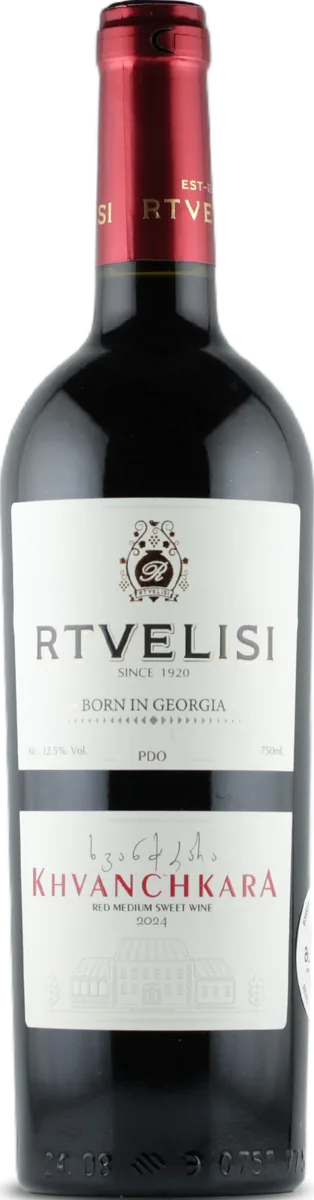
Khvanchkara · Racha-Lechkhumi · Naturally semi-sweet
Only you can see your marks and ratings.
A naturally semi-sweet red Georgian wine made from Aleksandrouli and Mujuretuli, appellation of Khvanchkara. Made using the European method; alcohol 12.5%. Sources note strawberry, caramel and dried fruit on the nose and long finish on the palate. Made at Rtvelisi.
What the bottle actually is.
Comparable values, collected the same way for every wine in the catalogue. Anything we do not know is left empty.
How to serve it, and what to expect in the glass.
Glass, temperature, food and occasion are catalogue suggestions, chosen mainly by the wine's colour, sweetness and tannin, not taken from reviews of it.
Glass
A medium tulip: sweetness reads without extra air, and a big bowl would only let the wine warm up.
How glass shapes differServing temperature
12–14 °C
Serve slightly chilled (12–14 °C); pairs with blue cheese, desserts, spicy dishes.
Aroma and taste
Stated by the producer and confirmed by retailersAroma
Taste
Hue
Goes well with
When to open it
What it costs, where, and how that moved.
Offers on record
2 shops
23 November 2026 · Shop promotion; regular price 52.50 ₾
23 November 2026
Price among similar wines
39 comparable bottles
Pricier than similar wines
Comparables share colour, sweetness and producer model: estates, négociants, cooperatives, or all other producers. Price is a reference, not a quality score.
Shelf price over time
From 22 August 2026 to 23 November 2026. The series ends on the figure this page quotes.
Other lots and formats
Under a shop's price are other lots and formats it currently sells. They are excluded from the median, the range and the comparison with similar wines: a different bottling year or a different bottle size is a different product, not the same wine at another price.
About these figures
The median of the shops above is the price quoted everywhere on this page. Each price carries the date it was collected; shop names open the shop's own listing.
When a shop runs a promotion and states its regular price, we show that price in the shop's row for reference. The median, the low and the comparison with similar wines use the price the wine is actually sold at.
Who made it, and what they are.
Where the grapes were grown.
On the map
All regionsRegion
216 wines in the catalogue
Appellation
What to check for Khvanchkara
Khvanchkara is a naturally semi-sweet red PDO from Racha, made only from Aleksandrouli and Mujuretuli grapes grown in a small demarcated micro-zone around Ambrolauri. Because these two grapes grow on a very limited area (the core micro-zone is on the order of tens of hectares, within roughly 900 ha of Racha vineyards) while the name is among Georgia's most famous, the volume sold under the name has historically exceeded what the zone can produce, and falsification of the name is well documented in the wine press. What to check: the producer is registered in the Racha/Khvanchkara zone and owns or buys Aleksandrouli and Mujuretuli grapes there, and the label names the Khvanchkara appellation. The winery's page on getwine shows where it is registered and its vineyards.
Medals, with the competition and the year attached.
A medal on its own is decoration. Each one here carries the competition, the year and the weight of that competition.
No awards on record
We do not invent recognition. When a competition publishes results for this wine, they appear here with the year and the weight of the competition.
The season, vintage by vintage.
What the season was like in Khvanchkara compared with the previous decade.
Weather explains what the season was like; it does not rate the wine or say when to open it.
How vintage weather is calculatedClose in style, not in price.
Matched on colour, sweetness, grape and region, and — where recorded — on tannin, aging vessel and technology. One wine per winery, none from this wine's own winery. Price plays no part, and no place is for sale.
Every claim on this page has a source.
Sources on this page
Glass, temperature, food and occasion are catalogue suggestions, chosen mainly by the wine's colour, sweetness and tannin, not taken from reviews of it.
Producers can respond
Rtvelisi can answer anything on this page. Responses are published next to the claim they answer.
If a figure here is wrong, the methodology page explains how we source, date and correct it.