About the variety
Budeshuri Saperavi is a red grape variety from Georgia. In the National Wine Agency's 2025 vineyard cadastre it covers 92 ha on 139 plots, 78 ha of them in Kakheti.
Budeshuri Saperavi — in ampelographic literature Saperavi Budeshuriseburi, 'Budeshuri-like Saperavi' — is a form of Saperavi with oval, elongated berries resembling those of the Budeshuri grape; VIVC records it as a Saperavi mutation. It was first described in 1895 in villages along the Iori and ripens somewhat earlier than ordinary Saperavi. Its wine is deeply coloured but lighter in body than that of Saperavi; Georgian regulations recommend it for Kakheti and Kartli.
- Berry colour
- red
- Origin
- Georgiaper VIVC passport
- Missing
- No data: tannin, photo
Geography
Appellations
- Permitted variety
- Akhoebi, Kakheti, Kindzmarauli, Napareuli
From the National Wine Agency's appellation specifications. Each zone's requirements are on its page.
Where it grows
- Kakheti78 ha · 85%
19 wines
- Kvareli25 ha · 27%
- Telavi22 ha · 24%
- Sagarejo15 ha · 16%
- Gurjaani6.9 ha · 8%
- Dedoplistsqaro5.1 ha · 6%
- Sighnaghi2.9 ha · 3%
- Other municipalities1.5 ha
- Kartli13 ha · 14%
4 wines
- Kareli3.9 ha · 4%
- Kaspi3.4 ha · 4%
- Gori2.2 ha · 2%
- Other municipalities3.7 ha
- Imereti0.2 ha · <1%
- Racha-Lechkhumi0.1 ha · <1%
- Guria0.1 ha · <1%
1 wine
Vineyard cadastre 2025, National Wine Agency: plots recorded under this variety. Wines by region are from our catalogue; the region is known for 24 of 35. 139 plots · Vine age: before 1990 — 1 ha, 1990–2009 — 18 ha, since 2010 — 72 ha
Ampelography
Variety passport
- Synonyms
- Boudechouri Chavi, Boudechouri Tziteli, Budescuri Tsiteli, Budeshuri Shavi, Budeshuri Vadisperi, Chabi Boudechouri, Shavi Budeshuri, Tamareouai
- Flower
- hermaphrodite
- Use
- wine and table
- Held in collections
- 10
Literature (10)
- SARGOLZAEI, M.; RUSTIONI, L.; COLA, G.; RICCIARDI, V.; BIANCO, P. A.; MAGHRADZE, D.; FAILLA, O.; QUAGLINO, F.; TOFFOLATTI, S. L.; LORENZIS, G. DE. Georgian Grapevine Cultivars: Ancient Biodiversity for Future Viticulture. Frontiers in Plant Science 12 (Art. 630122) 18 pp.. 2021
- MAGHRADZE, D.; MDINARADZE, I.; CHIPASHVILI, R.; ABASHIDZE, E.; KIKILASHVILI, S.; BARATASHVILI, M.; VIBLIANI, M.; KHARITONASHVILI, L.; BITSADZE, N.. Ampelographic Catalogue of Grape Varieties from Skra Collection. Shota Rustaveli National Science Foundation, Tbilisi, Georgia. 2017
- GALET, P.. Dictionnaire encyclopédique des cépages et de leurs synonymes. Éditions Libre & Solidaire (M.E.C.). 2015
- MAGHRADZE, D.; RUSTIONI, L.; TUROK, J.; SCIENZA, A.; FAILLA, O.. Caucasus and Northern Black Sea Region Ampelography. VITIS- Journal of Grapevine Research. 2012
- ROBINSON, J.; HARDING, J.; VOUILLAMOZ, J.. Wine grapes. A complete guide to 1.368 vine varieties, including their origins and flavours. Penguin Books Ltd.. 2012
- MAGHRADZE, D.; ROSSONI, M.; IMAZIO, S.; MAITTI, C.; FAILLA, O.; DEL ZAN, F.; CHKHARTISHVILI, N.; SCIENZA, A.. Genetic and phenetic exploration of Georgian grapevine germplasm. Acta Horticulturae, Belgium (827) 107-114. 2009
- MAGHRADZE, D.. Development of national programmes on plant genetic resources in Southeastern Europe - conservation and sustainable use of grapevine genetic resources in the Caucasus and Northern Black Sea region. 2006
- VOUILLAMOZ, J.F.; MCGOVERN, P.E.; ERGUL, A.; SOEYLEMEZOGLU, G.; TEVZADZE, G.; MEREDITH, C.P.; GRANDO, M.S.. Genetic characterzation and relationships of traditional grape cultivars from Transcaucasia and Anatolia. Plant Genetic Resources 4 (2) 144-158. 2006
- DEL ZAN, F.; FAILLA, O.; SCIENZA, A.. La Vite e l'Uomo, dal Rompicapo delle Origini al Salvataggio delle Reliquie. Ersa, Gorizia, Italy. 2004
- GALET, P.. Dictionnaire Encyclopédique des Cépages. Hachette. 2000
VIVC passport no. 1792, Vitis International Variety Catalogue.
In the vineyard
- Fungal diseases
- moderately resistant
- Frost
- moderately resistant
Georgian Wine Association, description of the variety in Georgia. A general characterisation, not measurements or a judgement of the variety: vines behave differently by plot and year.
Who makes it and how
- WinemakingWineries
- own winemaking and bottling11
- no data15
- MethodWines
- qvevri16
- European method4
- no data15
- Alcohol
typically 12.5–15%
- Competition medals
- International Wine & Spirit Competition3 wines
Wines
Wines from Budeshuri Saperavi

Saperavi Budeshuri
Shano
A dry red Georgian wine made from Budeshuri Saperavi. Sources note red berries on the nose. Awarded silver at Georgia International Wine Award (WinExpo Georgia) 2024. Made at Shano.
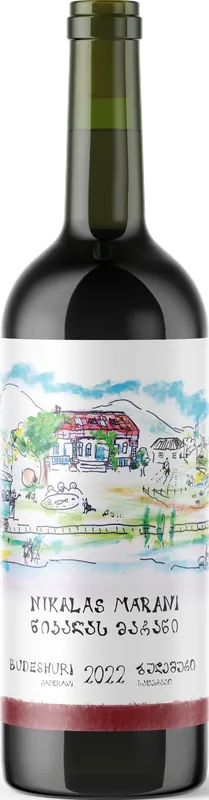
Budeshuri Saperavi
Nikalas Marani
Kakheti
Made at Nikalas Marani. Region of Kakheti: a dry red wine from Budeshuri Saperavi. The qvevri method, ageing in qvevri. Organic, low-sulfur and wild-yeast.

Budeshuri Saperavi
Tchotiashvili
Kakheti
Made using the traditional qvevri method, aged in a qvevri; alcohol 14.5%. Budeshuri Saperavi from Kakheti: a dry red Georgian wine. Sources note mineral, black pepper and chocolate on the nose and full-bodied on the palate. Produced by Tchotiashvili.

Budeshuri Saperavi
Winery Marienfeld
Budeshuri Saperavi: a dry red Georgian wine. Produced by Winery Marienfeld.
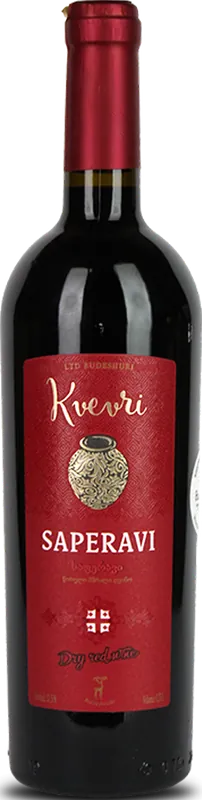
Saperavi Budeshuri
Budeshuri
Kakheti
Budeshuri Saperavi from Kakheti: a dry red Georgian wine. Made using the European method; alcohol 12.5%. Made at Budeshuri.

Budeshuri
Mildiani Family Winery
Kakheti
A dry red Georgian wine made from Budeshuri Saperavi, region of Kakheti. Sources note black pepper and blackberry on the nose and long finish on the palate. Awarded silver at Georgia International Wine Award (WinExpo Georgia) 2026. Produced by Mildiani Family Winery.

Budeshuri Saperavi
Sekhnika
Kakheti
Silver at International Wine & Spirit Competition 2026. Region of Kakheti: a dry red wine from Budeshuri Saperavi. As described by sources: on the nose, blackberry and plum. Produced by Sekhnika.
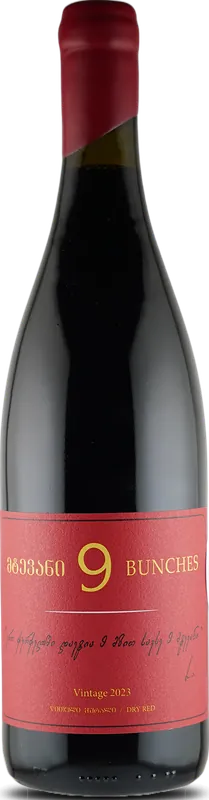
9 Bunches Red
Vazisubani Estate
Kakheti
Produced by Vazisubani Estate. A dry red Georgian wine made from Budeshuri Saperavi and Saperavi, region of Kakheti. The classic method, 13.5% alcohol. As described by sources: on the nose, cherry and plum; on the palate, long finish.
Where the data comes from
Sources for this page
Description
Facts from ampelographic sources and the country's official registers, in our own words.
Appellations
Zone specifications: which varieties are permitted and in what role.
Vineyard area
Vineyard cadastre 2025, National Wine Agency: plots registered under this variety; plots without an identified variety are not counted.
Passport and origin
Vitis International Variety Catalogue (VIVC).
In the vineyard
Georgian Wine Association's description, in our own words.
Wines
Our catalogue: the grape make-up comes from the winery's site or the label.
Found a mistake, a photo of a different variety, or know a better source? Tell us — we'll check and correct it.